Straight staircase
The simplest classic configuration — connects two levels in a straight line, with no turns and no change of direction.
01 /Main characteristics
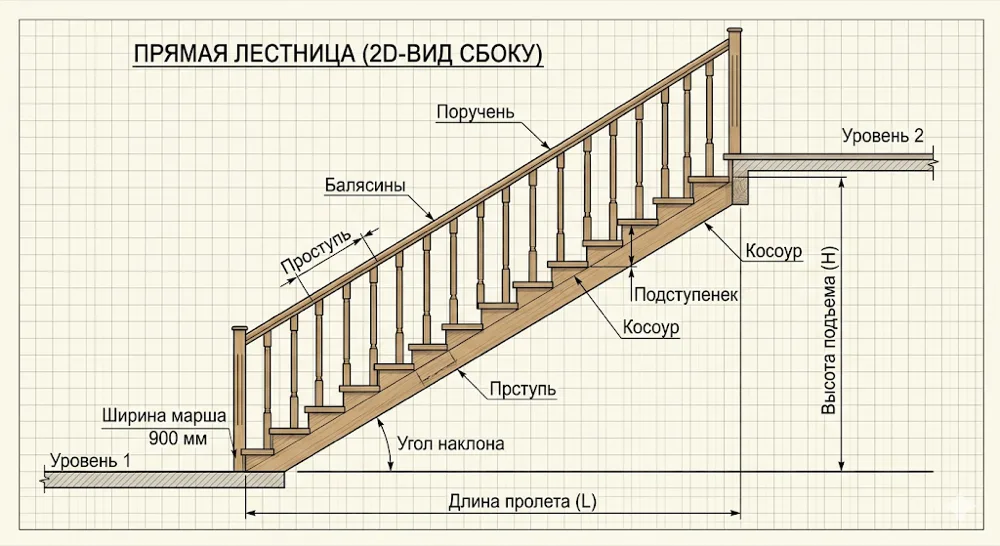
A straight staircase (a straight flight) is the simplest classic configuration that connects two levels or storeys in a straight line, with no turns, bends, or change of direction.
Single direction
Climbing and descending happen strictly along a single axis.
Flight structure
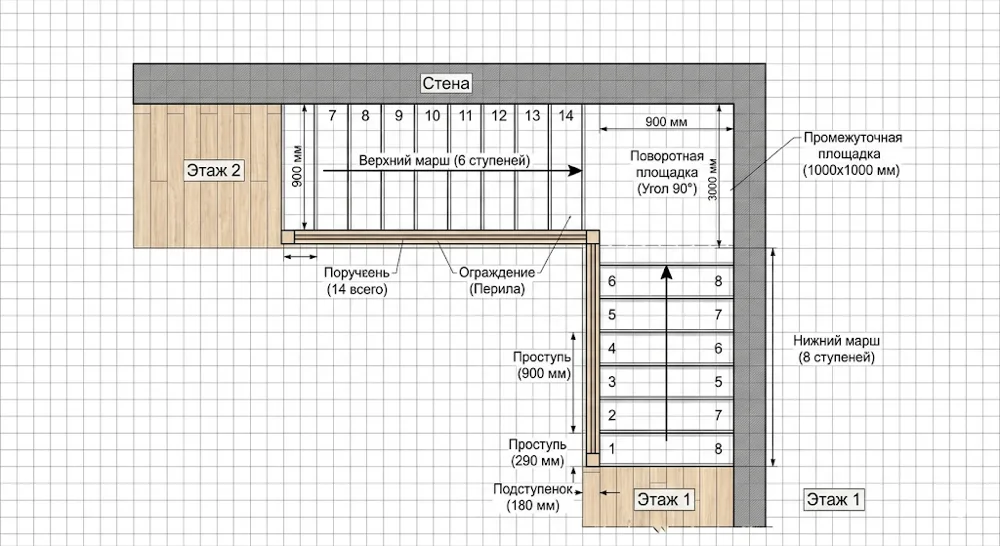
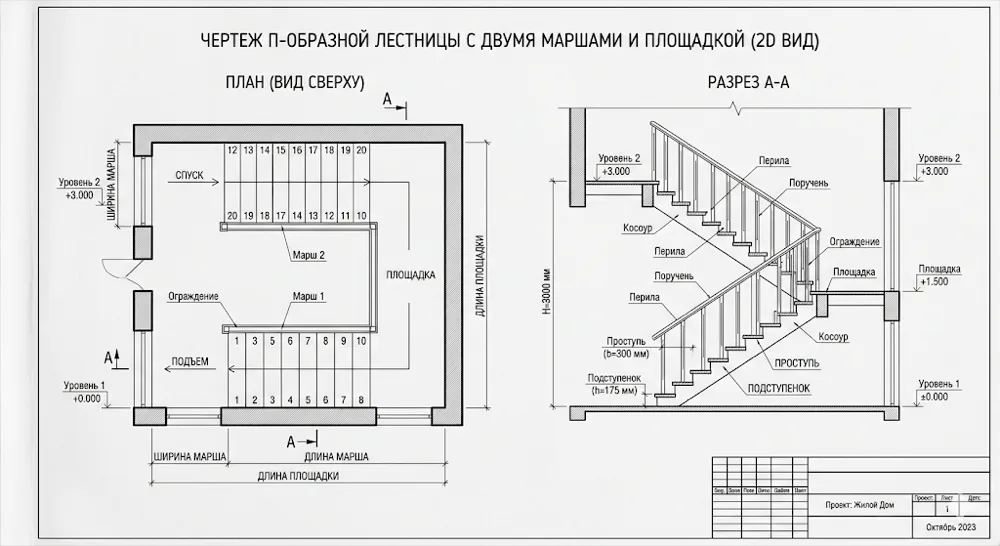
Most often it is a single continuous run of steps. If the stair is too long (usually more than 15–18 steps) it is split by a flat horizontal landing for rest, but the direction does not change after the landing.
Step shape
All steps have the same rectangular shape. There are no wedge-shaped (winder) steps in such stairs.
02 /Advantages
Maximum safety
It is the most comfortable and safest to use, which is especially important when children or elderly people live in the house.
Easy moving
Lifting bulky furniture, appliances, or building materials in a straight line is much easier than on a spiral or U-shaped staircase.
Simple design and installation
This is the easiest configuration to calculate and assemble, costing less than its more complex counterparts.
03 /Disadvantages
Needs a lot of space
The main and most significant downside. For the slope to be comfortable (around 30–45 degrees), the stair must be long enough. In a tight space — small private houses or duplex apartments — it can be hard to fit.