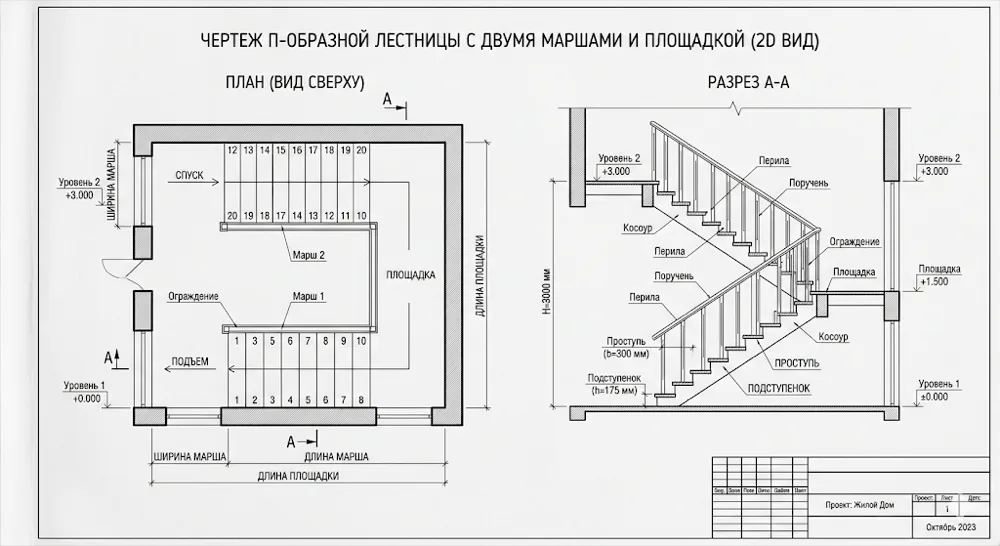
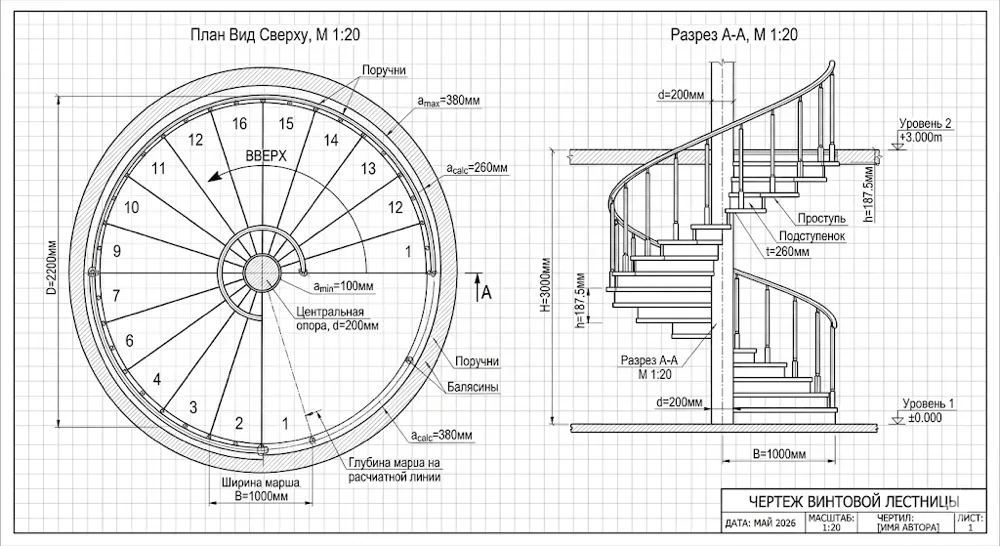
L-shaped staircase
A configuration of two flights at a right angle — forms an «L» from above. Often placed in a room corner; saves length.
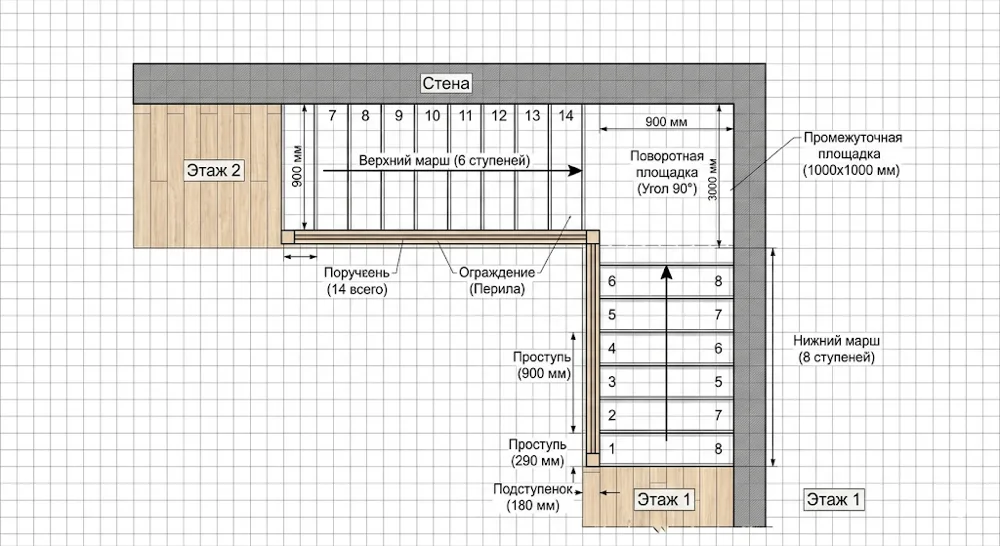
01 /How the 90-degree turn is arranged
An L-shaped staircase with a 90-degree turn (also known as a quarter-turn stair) is a configuration of two flights placed at a right angle to one another. Seen from above, it forms the letter «L».
Such stairs are usually installed in a room corner to make the most effective use of space.
There are two main ways to connect the two flights:
Through an intermediate landing
A flat horizontal landing (usually square) is installed between the lower and upper flights. This is the classic, very comfortable, and safe option.
Using winder steps
Instead of a landing, the turn uses several wedge-shaped (tapering to one edge) steps. This option lets you make the stair even more compact, but walking on winders is less comfortable, since on the inner side of the turn the tread is too narrow to support the foot.
02 /Advantages
Space saving
It occupies far less length than a straight stair and fits room corners perfectly.
Use of space
There is enough space under the upper flight and the landing to host a closet, built-in wardrobe, guest bathroom, or a small workspace.
Safety and rest
A stair with a landing provides a chance to rest while climbing. Additionally, the landing stops a fall: if someone slips on the upper flight, they will not tumble all the way down.
03 /Disadvantages
Complex design and installation
Requires more precise calculations and greater craftsmanship in assembly (especially the winder variant), making it more expensive than a straight stair.
Trouble moving bulky items
Carrying a long sofa, a non-disassembled wardrobe, or a large mattress to the second floor is harder because they must be turned 90 degrees in a confined space.