U-shaped staircase
Two parallel flights with a 180° turn — the most popular type in multi-storey buildings. «Folds» the length in half.
01 /How the 180-degree turn is arranged
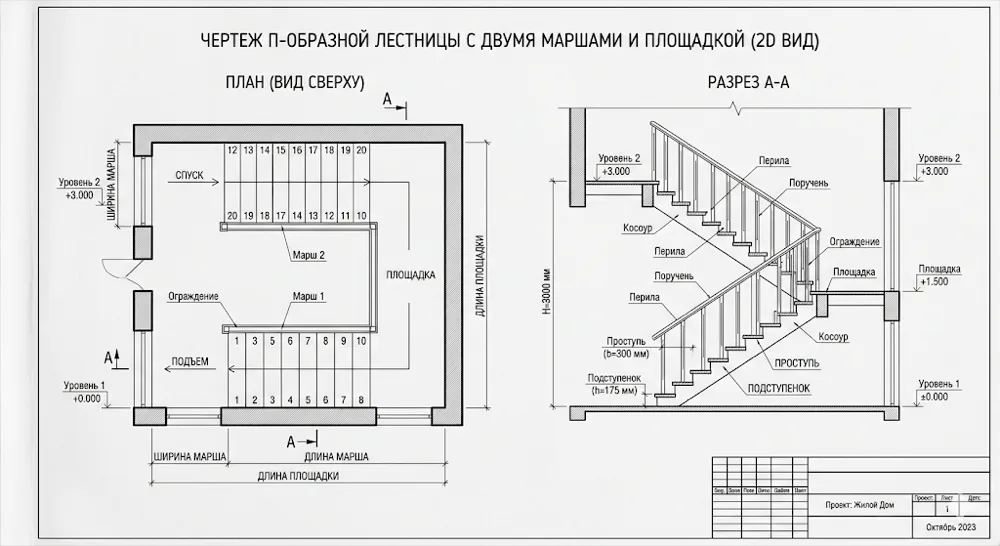
A U-shaped staircase (also known as a 180-degree turn stair) is a configuration of two parallel flights running in opposite directions. Seen from above, the outline forms the letter «U».
The key feature is that you change direction exactly 180 degrees as you climb or descend. It is the most popular type in multi-storey public and residential buildings — those familiar stairwell stairs are classic U-shapes.
As with the L-shaped stair, the two flights can be connected in two ways:
Through an intermediate landing (or two landings)
The flights are connected by a flat rectangular area. This is the most comfortable and safe option. In some spacious homes two square landings are made in a row with a small step between them.
Using winder steps
The flat landing is replaced by a group of wedge-shaped (tapering toward the inner radius) steps that smoothly turn the user around. This allows fitting the stair into an even tighter space but reduces safety and step comfort.
02 /Advantages
Ideal for high ceilings
If the distance between floors is large, a straight stair would be too steep or endlessly long. A U-shaped stair «folds» that length in half.
High safety and comfort
The intermediate landing acts as a rest zone, which is critical for elderly people. It also serves as a safety «buffer» interrupting a fall.
Efficient use of space
It fits well into dedicated stairwells, bay windows, or niches, leaving the useful room area free. The space under the lower flight can be used for storage.
03 /Disadvantages
Bulk
Takes more volume and area in the centre or corner of a room than a straight or spiral stair.
Furniture-moving problem
This is the construction's weakest point. Rotating a long non-disassembled sofa or mattress 180 degrees on a confined stair landing can be extremely difficult, sometimes impossible.
Higher cost
Due to the landing, additional supports, and the larger amount of materials, it is more expensive than a straight stair.