Spiral staircase
Steps arranged in a circle around a central axis — the most compact form, occupying 1.5–2 m². A striking decorative element.
01 /Main characteristics
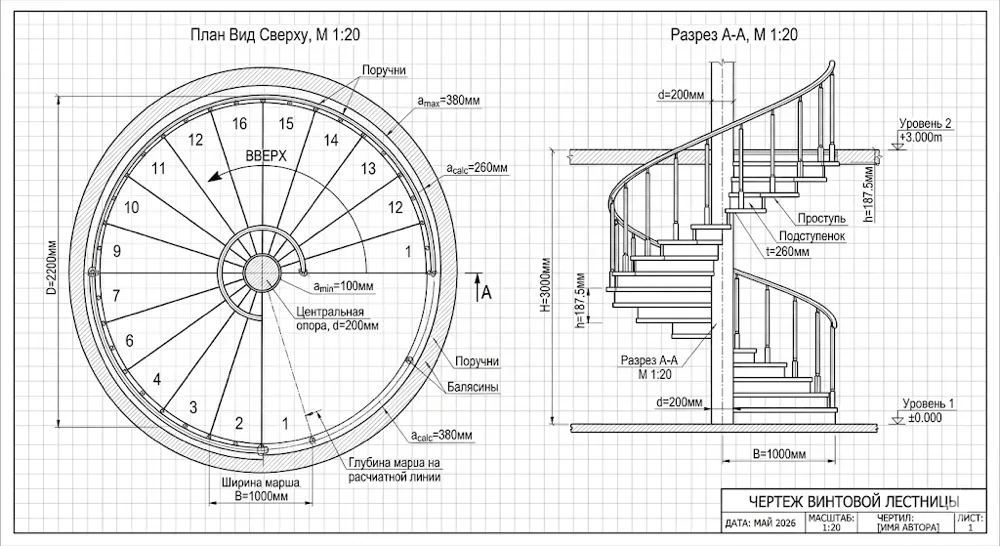
A spiral staircase is a configuration in which the steps are arranged in a circle, rising upward in a spiral around a central vertical axis or support post. From above, it forms a regular circle or polygon.
Central support
The base is usually a sturdy post (metal or wood) to which the steps attach by their narrow ends.
Step shape
All steps are winders (wedge-shaped). They are narrow at the central axis and widen toward the outer edge.
Circular movement
While climbing or descending you continuously turn, describing a full circle or part of it.
02 /Advantages
Maximum compactness
This is the absolute record-holder for space saving. A spiral stair can be installed on as little as 1.5–2 square metres.
Striking appearance
It looks very elegant and often becomes the main decorative element of the interior.
Independence from walls
It does not have to be tied to load-bearing walls — the stair can be placed in the middle of the room.
03 /Disadvantages
Low comfort and safety
Due to the tapering steps, the foot does not always have full support. Descending such a stair is hard and dangerous (especially for children and elderly people), and walking quickly is difficult.
No way to carry furniture
Carrying a sofa, wardrobe, or large appliance up a spiral stair to the second floor is practically impossible.
Cramped passage
It is very difficult (sometimes impossible) for two people walking toward each other to pass.