Room width
Distance between two opposite walls — the smaller dimension of a rectangular room.
01 /Main characteristics
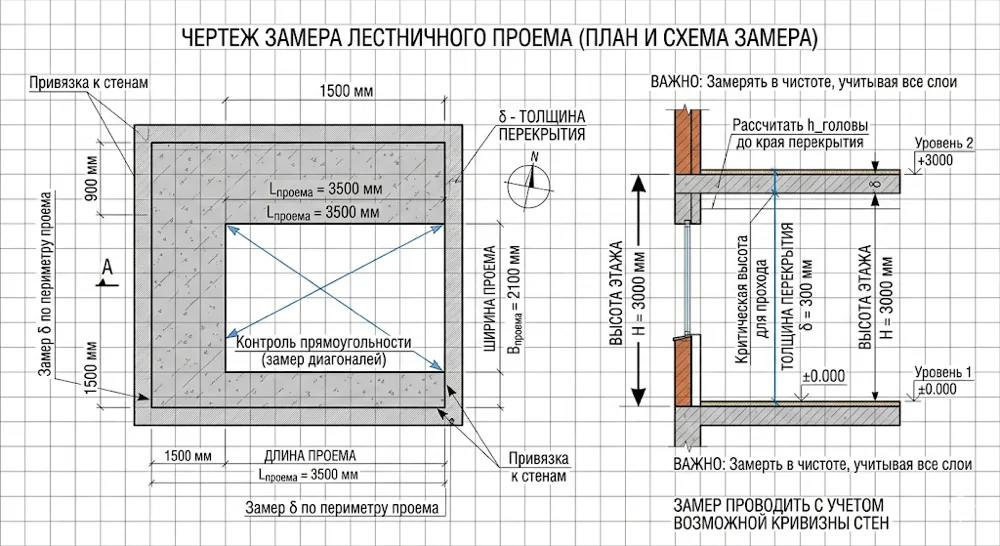
Room width is the distance between two opposite walls — the smaller dimension of a rectangular room. If you picture the room as a rectangle, the short side is the width and the long side is the length. In a perfectly square room, length and width are equal.
Notation
On drawings, width — like every other dimension — is given in millimetres. For example, if a plan shows 3000 next to the short wall, the room width is exactly 3 metres.
Complex shapes
If the room has a complex shape (L-shaped or tapering toward the window), the width is measured at several points, and drawings often note all dimension changes or the average usable width.
02 /Why exact width matters
Understanding proportions
Width is what determines how comfortable the room feels. Narrow, long rooms (width below 2.5 metres) are often called «pencil cases» or «railcars». They are harder to furnish because furniture must be arranged along one wall to keep a passage clear.
Furniture arrangement
Width determines whether you can place a double bed across the room with comfortable side aisles (the standard minimum aisle is 60–70 cm).
Visual correction
Knowing the exact width and length helps choose the direction in which to lay flooring (laminate, parquet). To visually «widen» a narrow room, the boards are laid across or diagonally.
Area calculation
Basic math: to get the room area in square metres, multiply width by length.