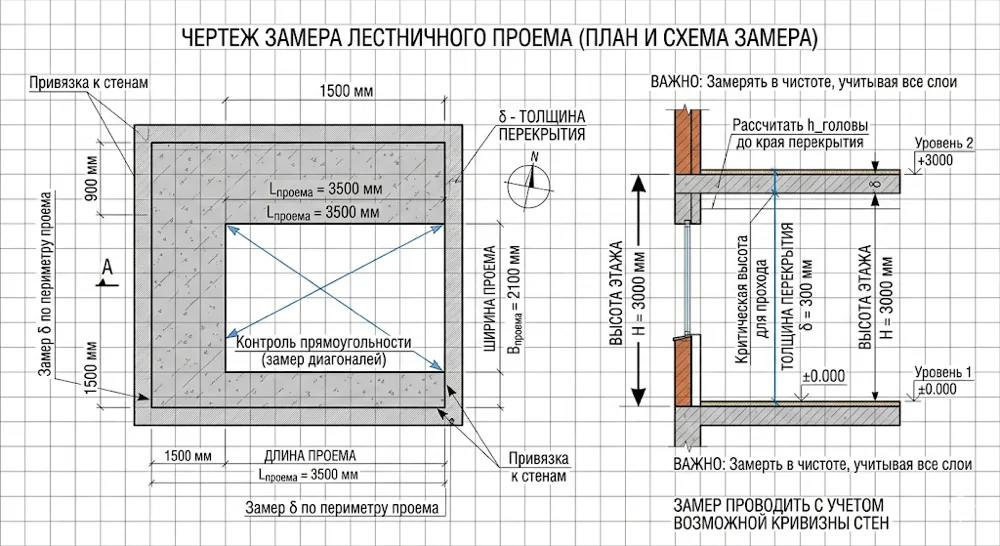
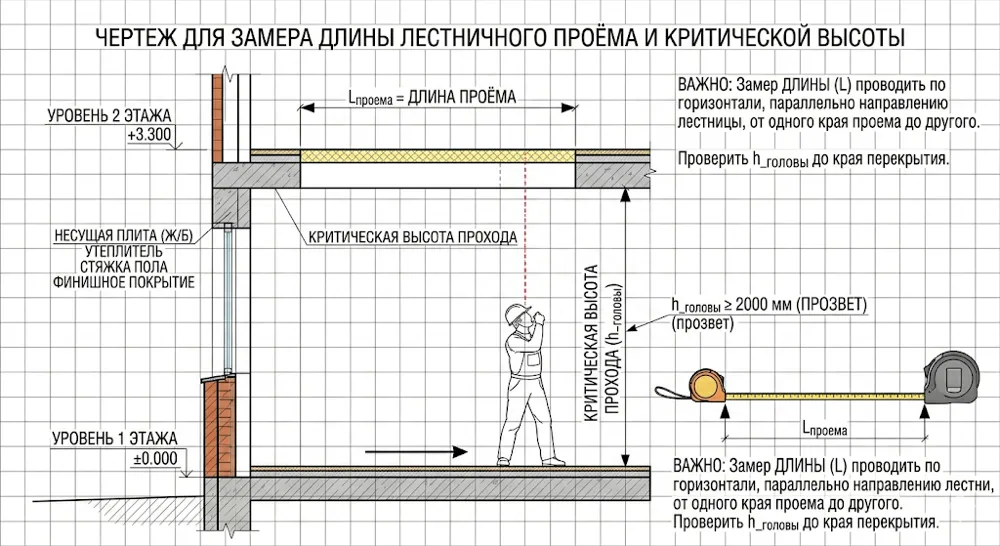
Slab thickness
Total thickness of the structure separating adjacent storeys — from the lower room's ceiling to the upper room's floor.
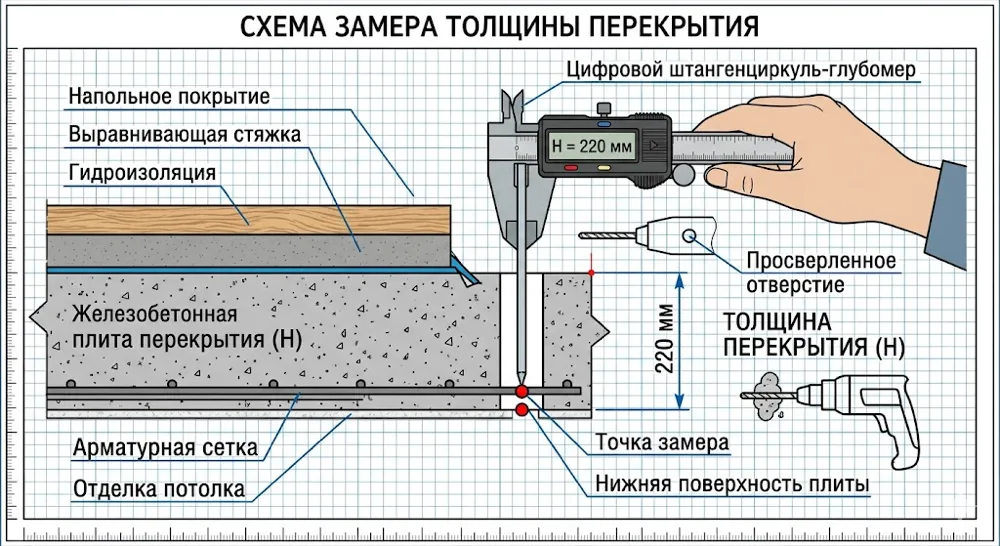
01 /What the slab «cake» contains (bottom to top)
Floor slab thickness is the total size of the entire structure that vertically separates two adjacent storeys. Put simply, it is the distance from your ceiling to the floor of the room above (or your own second storey).
Builders often call this construction the «slab cake», because it never consists of just one material — it is assembled from many layers.
Lower-storey ceiling finish
This can be a thin layer of plaster and paint (10–20 mm) or the framework for a suspended or stretch ceiling (50 to 150 mm).
Load-bearing base
The strongest and heaviest element. In apartment blocks it is usually a hollow-core or monolithic reinforced-concrete slab 160–220 mm thick. In private houses it may be wooden or metal beams.
Insulation layer
A layer of expanded clay, mineral wool, or special polystyrene (usually 30–50 mm) that dampens impact noise (such as footsteps) and retains heat.
Subfloor (screed)
A layer of cement-sand mix (50 to 100 mm) poured over the insulation to level the surface. Underfloor heating pipes or electrical wiring are often hidden inside the screed.
Final floor covering
The finish layer — underlay, laminate, engineered parquet, or ceramic tile (averaging 15–25 mm).
02 /Standard thickness values
Slab thickness depends strongly on the type of building:
Old prefab housing
About 220–250 mm. The slabs are thin and there is almost no soundproofing (linoleum was often laid directly on concrete), so audibility in such buildings is excellent.
Modern cast-in-place housing
On average 300–350 mm, since current building codes require mandatory soundproofing under a thick screed.
Private houses (wooden beams)
Can reach 350–400 mm, since a thick layer of insulation is laid between the tall beams.
03 /Why slab thickness matters
It is the slab thickness that «eats» part of the floor height. The thicker and more layered the «cake», the better the soundproofing between storeys. If you renovate a shell-and-core new build and plan to pour a screed with underfloor heating, calculate in advance how many millimetres this layer will take from your room height.
Also, if a stair attaches to the floor edge, the manufacturer can use this data to calculate the stair fastening method.