Opening
A through hole in a wall, partition, or floor slab. In the configurator, this means the stairwell opening.
01 /Main types of openings
In construction and architecture, an opening is a deliberately left or cut through-hole in a wall, partition, or floor slab. In the goldencalc stair calculator, an opening always refers to one in the floor slab — the stairwell opening.
Openings are needed to connect isolated rooms, allow people to pass through, let in daylight, or run utilities.
Doorway
A hole in a wall intended for installing the door frame and door leaf.
Window opening
An opening, usually in an exterior wall, for installing a window.
Stairwell opening
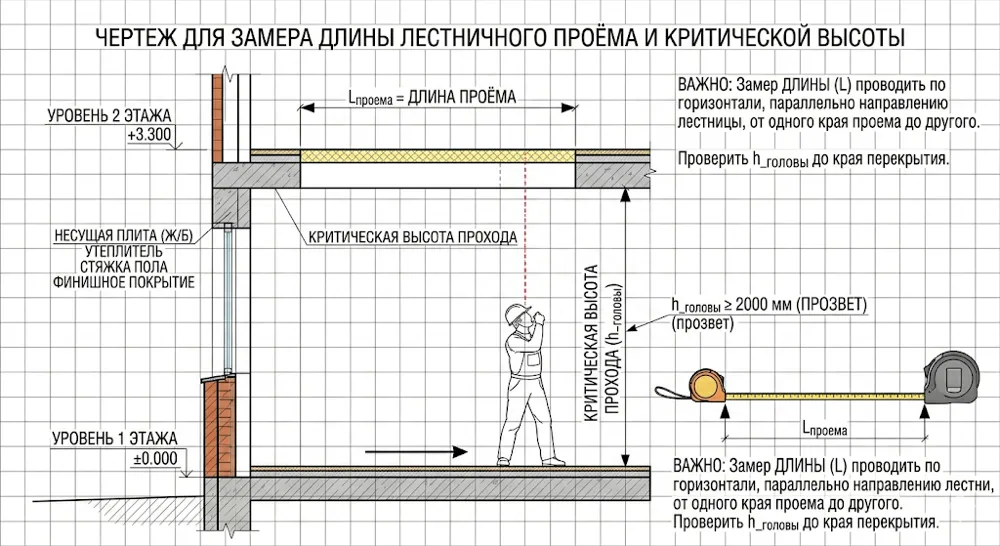
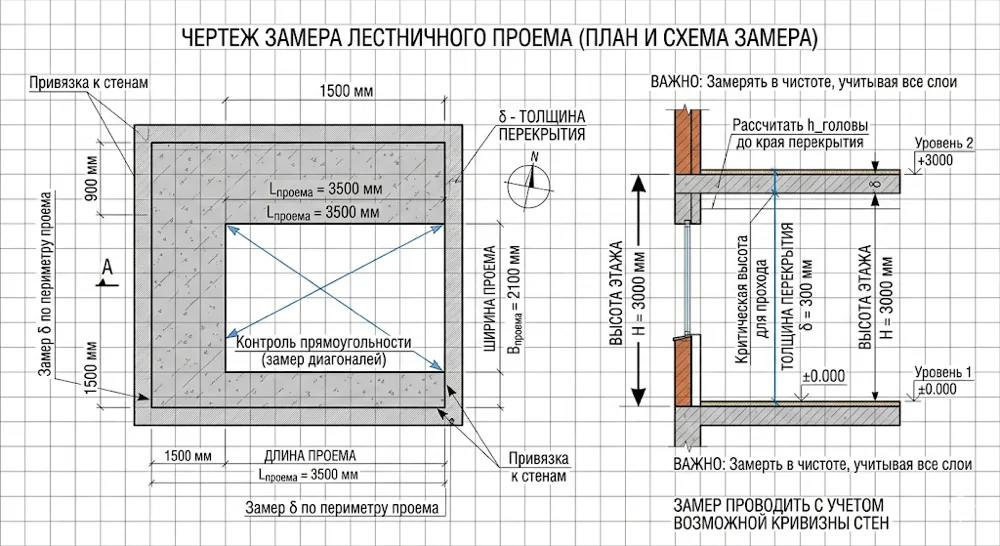
A large through-hole in the floor slab — in that very multi-layer «cake». The stair (straight, U-shaped, spiral, etc.) passes through this opening to connect the storeys.
Service (engineering) opening
Small holes in walls or slabs through which water and sewer pipes, ventilation ducts, or electrical cables are run.
Open passage (e.g. archway)
A wall passage left open on purpose, without doors, to visually merge two rooms (kitchen and living room, or hallway and lounge).
02 /An important rule: the lintel
The main problem with any wall opening is that a part of the wall hangs above the empty space and can collapse under its own weight.
That is why a lintel — a sturdy horizontal beam (reinforced concrete, heavy timber, or steel channel) — is always installed above door and window openings. The beam rests on the wall edges either side of the opening, takes the weight of every brick or block above, and reliably holds the construction. For a load-bearing wall, calculating the lintel is one of the engineer's most important tasks.
03 /What you usually see on opening drawings
The slab itself
The slab or beams in which the empty space is left.
Opening dimensions
They must be large enough to prevent a person climbing from hitting their head on the slab edge (the distance from any step to the ceiling should usually be no less than 2 metres).
Edge framing
The opening edges (especially when cut into wooden beams or monolithic concrete) are often additionally reinforced to compensate for the loss of structural integrity.