Tread thickness
Vertical size of the horizontal part you step on. Affects strength, freedom from squeaks, and precise step-height calculation.
01 /Why this dimension matters
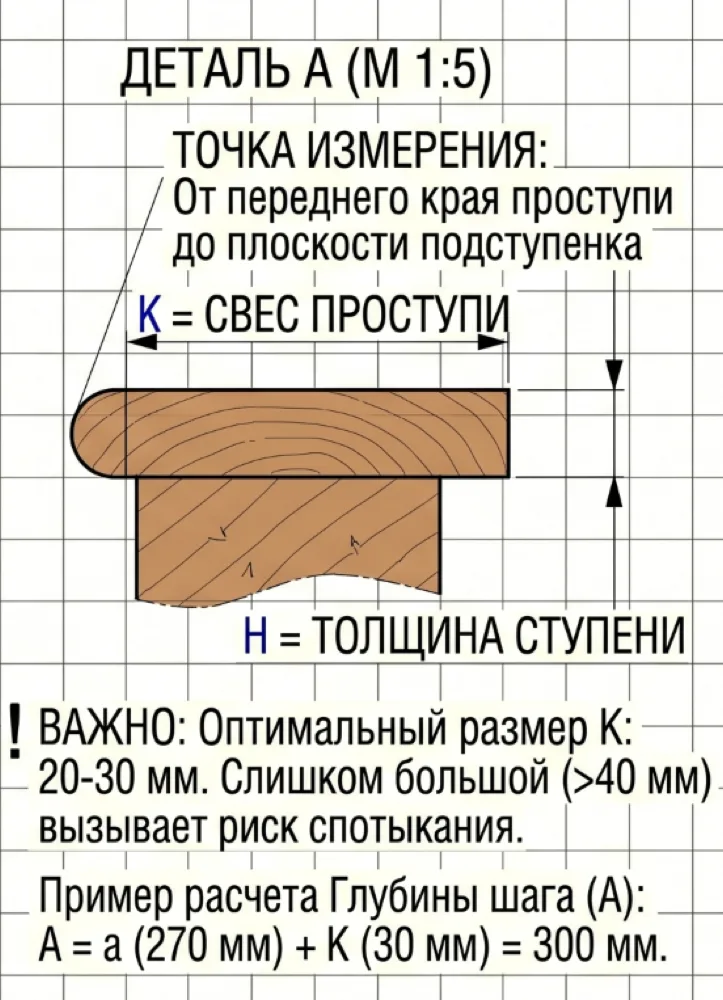
Tread thickness is the vertical size of the horizontal part of the stair on which you place your foot when climbing or descending.
If you picture a step as a regular board lying on a frame, tread thickness is the thickness of that very board.
Strength and safety
The tread must not bend under a person's weight (even a very large one) or when two people step on it at once while moving heavy furniture. Insufficient thickness leads to deformation and fracture.
No squeaks
On wooden stairs, treads that are too thin «play» (spring) when walked on, which loosens fasteners over time and causes loud squeaks.
Step-height calculation
When designing a stair, the height of each step (the distance from one tread surface to the next) includes the tread thickness itself. If you get the material thickness wrong at the drawing stage, the top and bottom steps will end up at a different height from the others, making the stair uncomfortable and dangerous (the «tripping effect»).
02 /Standard thickness depends on the material
Wooden treads
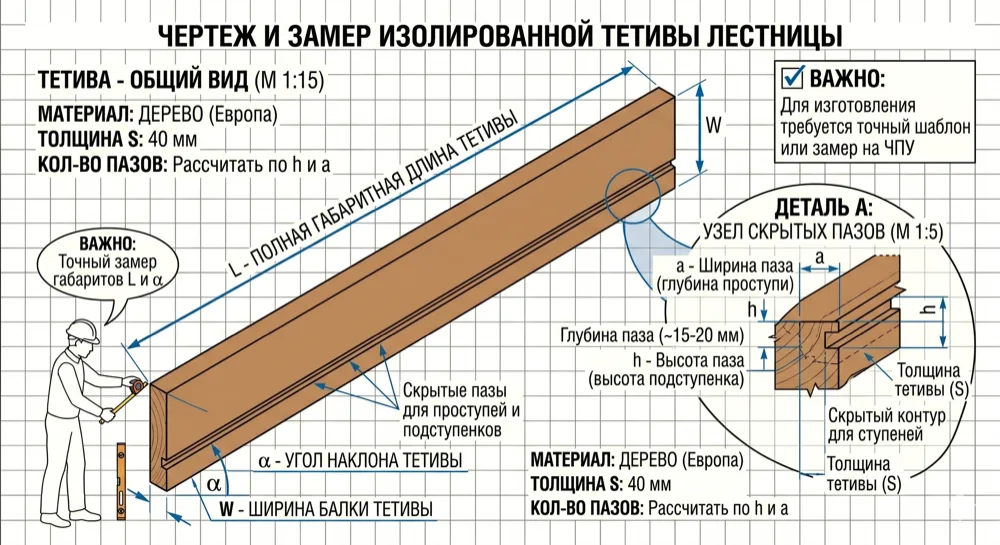
The gold standard for private houses is 40 mm (sometimes 50 mm). Treads thinner than 35 mm bend (especially when the flight width exceeds 900 mm). Treads thicker than 50 mm are rare — they are too heavy and expensive.
Concrete treads (monolithic)
In reinforced-concrete stairs, the thickness of the «toothed» part of the tread is usually about 100–150 mm including the working reinforcement.
Metal treads
If a tread is made of checker steel plate (for example, outdoor or fire stairs), its thickness can be just 3–5 mm, but it must be reinforced underneath with a steel angle or square tube (a frame) to prevent bending.
Glass treads
Modern designer stairs use special tempered laminated glass (triplex). Such a tread's thickness is calculated by engineers individually but usually comes to 30–40 mm (e.g. three 10-mm panes glued together with polymer interlayers).
03 /How to measure thickness correctly
Measurement is taken at the front edge of the tread from top to bottom — from the finished surface you step on to the bottom plane of the same part.