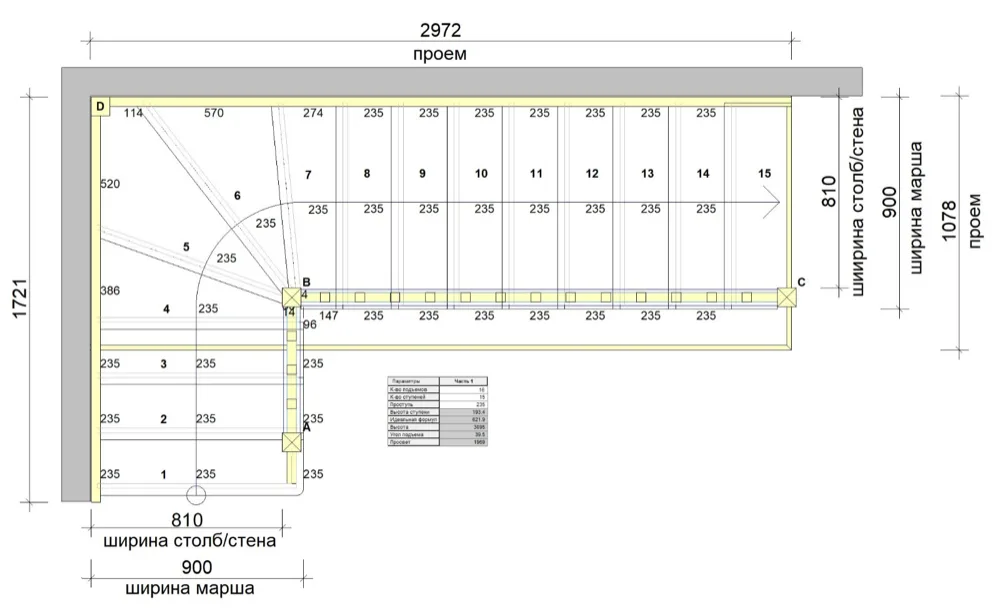
Opening width
The transverse dimension of the opening, perpendicular to the direction of ascent. Defines shoulder comfort and the ability to carry large furniture upstairs.
01 /How the opening width is calculated
Stairwell opening width is the transverse dimension of the through hole in the floor slab. It is measured perpendicular to the direction of ascent — from one lateral boundary of the cutout to the other.
While the opening length keeps your head clear of the ceiling, the opening width determines how comfortable you will be at the shoulders and whether you can carry large furniture upstairs.
The ceiling opening must always be a bit wider than the stair itself. The calculation comprises several factors:
Clear flight width
For comfortable single-person movement in a private house, the steps themselves should be at least 900–1000 mm wide.
Installation and service gap
A stair is never placed flush with the cutout edges. A technical gap of at least 50–100 mm is always left between the step edge (or handrail) and the slab end on each free side. This allows finishing the slab edge with drywall or wood and prevents you from rubbing your sleeve against the lower-storey ceiling or jamming your hand between the handrail and the slab while walking.
Construction type
For a straight stair the opening width is simple: flight width + gaps (e.g. stair 900 mm + 100 mm gap = 1000 mm opening). For a U-shape (two parallel flights) the opening width is much larger: first flight + clearance between flights + second flight + gaps. Such an opening is usually 2 to 2.5 metres wide.
02 /Why this dimension is critical
Installing handrails and railings
Handrails consume part of the useful stair width. If the opening is cut flush with no allowance, your hand on the rail will keep catching on the slab edge.
Maneuvering freedom
A narrow opening feels cramped both visually and physically. A wide opening makes climbing safer and brighter.
Moving furniture upstairs
This is the main everyday problem with narrow openings. Even if the length lets you pass through yourself, the narrow width will not let you turn and carry a non-disassembled sofa, bathtub, or large double mattress upstairs.
End gap for finishing
Account for the thickness of materials used to clad the slab end (drywall, wood). A gap of about 20–50 mm is usually required.